Thought it was about time we did another one of these. Looking through my archives, I found a bunch of arcade production line photographs that to my knowledge, haven’t been shared before.
I originally posted some arcade factory pictures exactly a decade ago here – which is also worth checking out if you missed it. (Holy smokes, is the blog really over 10 years old now?)
We’re going to jump around a bit, and these images are in no particular order, but let’s start at the fledgling early years of the arcade industry with a newspaper clipping from late 1972 which shows and details Atari’s Pong production facility in Santa Clara, CA.
You can click on each image below to view its full size:
Click the image for a bigger version to read the copy
And fast forward to March 1974. This image shows Atari’s Quadrapong being built at the same factory. It was a groundbreaking four-player version of Pong developed and designed by Steve Bristow, and was famously recognized as the first arcade game to be housed in a cocktail table cabinet:
Quadrapong arcade cabinets being constructed – March 1974. The production line was pretty crude back then!
Let’s cross over to Japan and take a look at Taito’s production line for this great shot:
There’s a lot going on in this picture. The cockpit cabinets in the foreground are Taito’s Super Speed Race Jnr cabinets (note the castors on the front designed to help move the cabinets around). In the background on the right are rows of Taito’s vertical shooter, Wyvern F-0, and the green cabinets you can just make out in the background on the left are Taito’s MA1 cabinets
Taito’s Super Speed Race Junior is an interesting one. Never seen one before, but it was designed to teach kids about road and traffic safety. Check out this video of the gameplay:
Super Speed Race Junior gameplay. Cool!
Here’s the flyer for Taito’s Wyvern F-0 which shows a better picture of the cabinet:
Taito’s Wyvern F-0
And if you’ve never seen a Taito MA1 cabinet, here’s a pair of them:
The MA1 cabinet was highly adaptable with a connector allowing all sorts of games to be played, including Jamma PCBs and Majong type games. The cabinets are constructed out of wood with a green laminate on the sides which you can make out in the factory shot above – its a really cool and unique design. It was a Japan only release. (thanks for Oliver Moazezzi for the pic)
Atari of course were the masters of arcade cabinet production throughout their active coin-op years. Here’s a series of shots that I thought were interesting:
August 1991 – The development team behind Atari Games’ (terrible!) Pit Fighter, photographed here on the production line
June 1991. Atari Games’ Road Riot 4WD development team with newly built cabinets on the production floor.
August 1991. The team behind Atari Games’ Steel Talons. I recognise Ed Rotberg (Battlezone) in the background with the moustache, and Ed Logg (Asteroids) leaning on the cabinet on the right of the picture. You can just make out the first built Steel Talons cockpit cabinet in the background!
June 1988. Same factory, different game. Atari’s Toobin’!
Atari’s Paperboy seen here in April 1985. Housed inside Atari’s versatile System 2 arcade cabinets
Atari workers soak testing a Roadblasters cockpit machine. Circa march 1987. Anyone recognise these two Atari employees?
Another shot taken on the same day. Note the cockpits on the left there. 5610 cabinets were constructed and sold in the USA
Atari’s Liberator was released in 1982 when this shot was taken. A rare cabinet these days. Just 762 were built
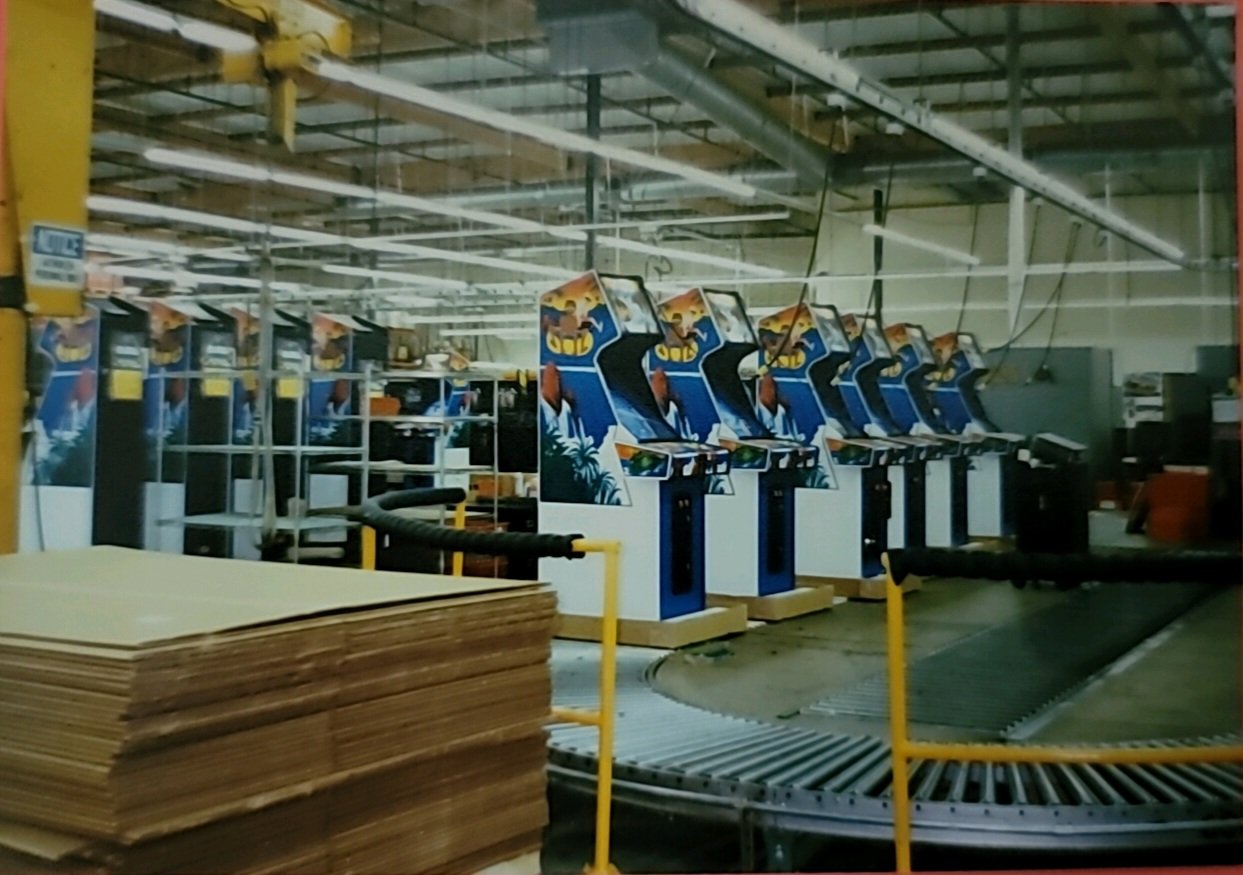
I love this shot. July 1983 – Atari’s Crystal Castles on the production line. 4880 uprights were produced
Just down the road at Sunnyvale, California, less than a mile away were one of Atari’s competitors, Exidy:
October 1983. A rare shot from the Exidy factory. An employee completes the final task on the production line of assembled Crossbow arcade cabinets, by boxing up the game ready for shipping.
In 1986, Sega Japan’s primary corporate headquarters and arcade cabinet production base was located in Ōta Ward, Tokyo, near Haneda Airport (specifically at 1-2-12 Haneda, Ōta-ku). This location served as the epicenter for both their corporate operations and global game production during the arcade boom:
June 1986. Here’s a Sega employee posing next to an assembled sitdown Sega Enduro Racer at the Haneda facility
July 1985. Not the best resolution, but you can make out that these are Sega’s Hang-On cabinets pictured here on the Sega production line, again at Haneda, Tokyo
Sega Hang On cabinets being constructed in the Sega factory. Shout out to x.com user @xga24837632 who took pity on the dreadful image above and shared this one! Thanks xga!
Sega’s R360 made its public debut at a press event in Shibuya, Tokyo on July 3, 1990. It officially launched in Japanese arcades in November 1990, with a wider international rollout following in early 1991. The machine was notoriously built more like an amusement ride than a standard cabinet. It required dedicated on-site attendants and utilized a floor space capable of supporting its massive, 360-degree hydraulically spinning gyroscopic sphere. Most cabinets were loaded with a modified version of the flight combat game G-LOC: Air Battle. Here’s a shot taken at Sega’s production facility
Each 1.5-ton gyroscope unit and moving cockpit was welded, wired, and assembled largely by hand. The labor-intensive, custom-built nature of these machines limited production to just three units per day, and total production was capped at 150 units. Most R360s were sold for ¥16 million each, which equated to around $100,000 in 1990 dollars.
The summer of 1981 saw Taito America build a new corporate headquarters in Elk Grove Village, Illinois, right next door to Chicago’s O’Hare airport. It was a 60,000 square foot facility, housing a modern factory and administrative offices:
Taito America Corp offices in Chicago. The facility lasted just 3 years, demonstrating the fickle nature of the 80s arcade industry. It was shut down in September 1984
September 1981. Rows of newly assembled Qix cabinets are pictured here. This would be the first cabinet built at the new Taito America facility in Chicago
Top left pictured are: Mark Pugh, VP of accounting, Rene Lopez director of customer service, president Jack Mittell, David Poole VP of Engineering and Mike Con Kennel, sales manager. Top middle: a factory employee testing a PCB. Top right: a view of the facility’s spacious factory space. Bottom left: rows of QIX cabinets. Bottom middle: an employee tests security locks for Qix coin doors. Bottom right: Mattell overseeing testing procedures for Qix.
More from the Qix cabinet build operation at Taito America. Note the box of parts crudely labelled “Qix” on the table, and the control panel in the immediate foreground. These employees appear to be making wiring looms
I’ve got some Bally Williams factory production footage to share in a future post, but meantime here’s a never seen before shot of Joust cocktail tables being constructed at their factory in Chicago (note: I digitally tided up this pic and added some colour as the original was very poor):
July 1982: Joust cocktail cabinets at the Williams arcade factory. The cabinet had an estimated production run of 500 units. Edit: I’m told by KLOV user SynaMax that this image came from this book, which is worth checking out!
The Joust cocktail cabinet was engineered by Leo Ludzia, and features a unique side-by-side seating arrangement rather than the traditional opposite-end layout, which allowed Williams to use the exact same ROM chip as the upright version:
Joust cocktail table. A very unique and rare cabinet (image credit: Antonio Borba)
Finally, here’s a collage of shots from the Atari factory taken during Xevious‘ production run in February 1983. 5,295 cabinets were produced for the North American market:
Pictured clockwise from top left are: Carl Nielsen, director of LSI Testing & Design, in charge of developing the integrated circuits used in the silicon chips for PCB creation. Two workers in the company’s wood shop, cutting a board into a side panel for the Xevious cabinet. A finished upright cabinet of Atari’s Xevious being hoisted via crane for boxing. An employee silk-screening the side art graphics onto a Xevious cabinet
I hope you enjoyed this trip to the arcade factory floors of the 70s, 80s and 90s. I’d appreciate if you would consider sharing this article on the socials!
Thanks for reading this week. More cool stuff is in the works!
Great stuff. Enjoyed having a peek at the world of video games us punters almost never got to see at the time. They seemed to magic themselves into the arcades, Robert Maxxe like, as far as I knew.
Fantastic article, Tony. It’s incredible to see these behind-the-scenes photos from the factories that helped create the golden age of arcade gaming. Seeing the production lines, the teams behind the machines, and the craftsmanship that went into these cabinets really shows how much passion and effort was involved. Thanks for preserving and sharing this amazing piece of arcade history. Looking forward to more!
Loading...
Leave a Reply
Discover more from The Arcade Blogger
Subscribe now to keep reading and get access to the full archive.




Wonderful stuff. Thanks for sharing Tony. Regards
Great stuff. Enjoyed having a peek at the world of video games us punters almost never got to see at the time. They seemed to magic themselves into the arcades, Robert Maxxe like, as far as I knew.
Fantastic article, Tony. It’s incredible to see these behind-the-scenes photos from the factories that helped create the golden age of arcade gaming. Seeing the production lines, the teams behind the machines, and the craftsmanship that went into these cabinets really shows how much passion and effort was involved. Thanks for preserving and sharing this amazing piece of arcade history. Looking forward to more!